

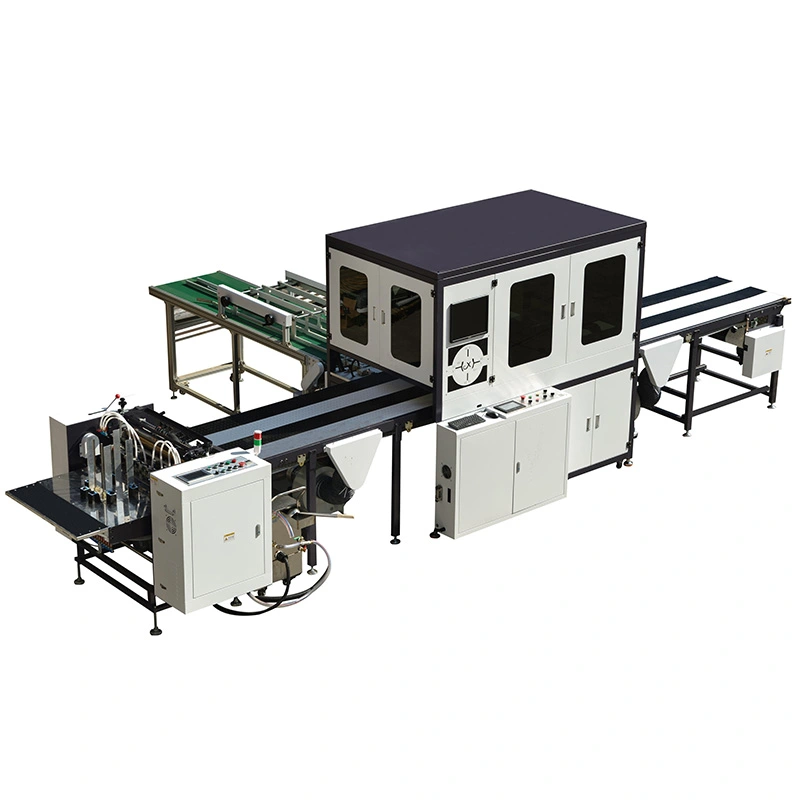
In the packaging and rigid box manufacturing industry, positioning accuracy plays a critical role in determining the final product quality. Whether aligning printed paper, placing greyboard, or assembling decorative elements, precise positioning ensures a flawless appearance and structural integrity. Traditionally, positioning tasks were handled manually or with basic mechanical guides, relying heavily on operator skill and experience. While these methods served the industry for decades, they are increasingly unable to meet modern demands for speed, precision, and consistency.
The introduction of the automatic visual positioning machine has transformed this aspect of production. By integrating camera-based vision systems, intelligent software, and automated mechanical controls, these machines can achieve real-time positioning with exceptional accuracy. This article provides a comprehensive comparison between automatic visual positioning machines and traditional positioning methods, helping manufacturers determine the best solution for their production needs.
Traditional Positioning Methods: Overview and Limitations
Traditional positioning methods in packaging production typically involve manual alignment or simple mechanical guides. Operators visually inspect materials, align edges by hand, and use tools such as rulers, stops, or templates to achieve approximate positioning. While this approach offers flexibility, especially for small batches or custom designs, it has significant limitations.
One of the main drawbacks is inconsistency. Human operators, regardless of experience, may produce slight variations in alignment, particularly during long production runs. Fatigue, environmental factors, and subjective judgment can lead to positioning errors, which ultimately affect product quality. Additionally, manual positioning is time-consuming, reducing production speed and limiting scalability.
Mechanical positioning systems improve consistency to some extent but still lack adaptability. Fixed guides may not accommodate different box sizes or designs without manual adjustments, which increases downtime. As packaging designs become more complex and quality expectations rise, traditional methods struggle to meet industry requirements.
Automatic Visual Positioning Machine: A Modern Solution
The automatic visual positioning machine represents a significant advancement over traditional methods. Instead of relying on human judgment or fixed mechanical guides, it uses cameras and image processing technology to detect the exact position of materials.
This machine captures images of the workpiece, identifies reference points such as printed marks or edges, and calculates the precise alignment required. It then automatically adjusts the material using servo-driven systems or robotic components. This process occurs in real time, ensuring high-speed operation without compromising accuracy.
Unlike traditional methods, the automatic visual positioning machine adapts to different product designs, materials, and sizes with minimal setup changes. Its ability to store multiple configurations allows operators to switch between production tasks quickly. As a result, manufacturers benefit from improved efficiency, reduced errors, and consistent product quality across large production volumes.
Precision and Quality Comparison
Precision is the most critical factor when comparing positioning methods. Traditional positioning relies heavily on operator skill, which introduces variability. Even small misalignments can lead to visible defects, such as uneven edges, misaligned prints, or poorly assembled boxes.
The automatic visual positioning machine eliminates these issues by using digital image processing and precise mechanical adjustments. It can achieve alignment accuracy at a level that is difficult to replicate manually. This is especially important in industries such as cosmetics, electronics, and luxury packaging, where appearance is closely tied to brand value.
Furthermore, automatic machines maintain consistent precision regardless of production speed or duration. This consistency ensures that every product meets the same high standards, reducing the risk of customer complaints and product rejection.
Efficiency and Production Speed
Efficiency is another area where the automatic visual positioning machine clearly outperforms traditional methods. Manual positioning requires operators to align each piece individually, which slows down production and increases labor costs. Even with skilled workers, production speed is limited by human capability.
In contrast, automatic machines operate continuously at high speed, aligning multiple components per minute with minimal human intervention. Integrated feeding systems and automated controls allow for uninterrupted production, significantly increasing throughput.
This efficiency is particularly beneficial for large-scale manufacturers handling high-volume orders. Faster production not only reduces lead times but also enables companies to respond quickly to market demands, improving competitiveness and customer satisfaction.
Cost and Return on Investment
Cost is a key consideration when choosing between traditional and automated positioning methods. Traditional methods have lower initial investment costs but higher long-term expenses due to labor, material waste, and lower productivity. Errors in manual positioning often result in rejected products, increasing overall production costs.
The automatic visual positioning machine, while requiring a higher upfront investment, offers substantial long-term savings. Reduced labor requirements, minimized material waste, and increased production efficiency contribute to a faster return on investment. Additionally, consistent quality reduces the need for rework and enhances brand reputation, which can lead to increased customer satisfaction and repeat business.
For manufacturers aiming to scale operations or enter high-end packaging markets, automation provides both economic and strategic advantages.
Flexibility and Integration Capabilities
Flexibility is essential in modern packaging production, where product designs and requirements frequently change. Traditional positioning methods require manual adjustments for each new design, which increases setup time and reduces efficiency.
The automatic visual positioning machine offers superior flexibility through programmable settings and adaptive vision systems. Operators can store multiple production configurations, enabling quick transitions between different products. This capability is particularly valuable for manufacturers handling diverse orders or customized packaging solutions.
Additionally, automatic machines integrate seamlessly with other equipment, such as V grooving machines, corner pasting machines, and rigid box forming machines. This integration creates a fully automated production line, improving workflow efficiency and ensuring consistent quality across all stages of production.
Our Company and Solutions
Dongguan Pinchuang Automation Equipment Co., Ltd. is a professional manufacturer of advanced packaging machinery, including automatic visual positioning machines designed for high-precision rigid box production. Our machines combine cutting-edge vision technology with reliable mechanical systems to deliver consistent performance and exceptional accuracy.
We provide a comprehensive range of packaging solutions, including automatic rigid box machines, V grooving machines, corner pasting machines, and paper gluing machines. Our equipment is engineered for flexibility, allowing manufacturers to handle various materials, sizes, and production volumes efficiently.
With extensive industry experience, we offer customized solutions, technical support, and training services to ensure optimal machine performance. By choosing our automatic visual positioning machines, clients can improve productivity, reduce waste, and achieve superior packaging quality in competitive markets.
FAQ
Q1: What is an automatic visual positioning machine?
An automatic visual positioning machine is a system that uses cameras and software to detect and align materials accurately during packaging production.
Q2: How does it compare to traditional positioning methods?
Unlike traditional methods that rely on manual alignment, automatic machines provide consistent, high-precision positioning with faster production speed and reduced errors.
Q3: Why is it better for high-end packaging?
High-end packaging requires perfect alignment and visual quality. Automatic visual positioning machines ensure consistent precision, enhancing product appearance and brand value.
Q4: Can it improve production efficiency?
Yes, it significantly increases production speed by automating alignment tasks, reducing manual labor, and enabling continuous operation.
Q5: Is it worth the investment?
Although the initial cost is higher, the long-term benefits—such as reduced labor, lower waste, and improved efficiency—make it a cost-effective solution for modern manufacturing.