

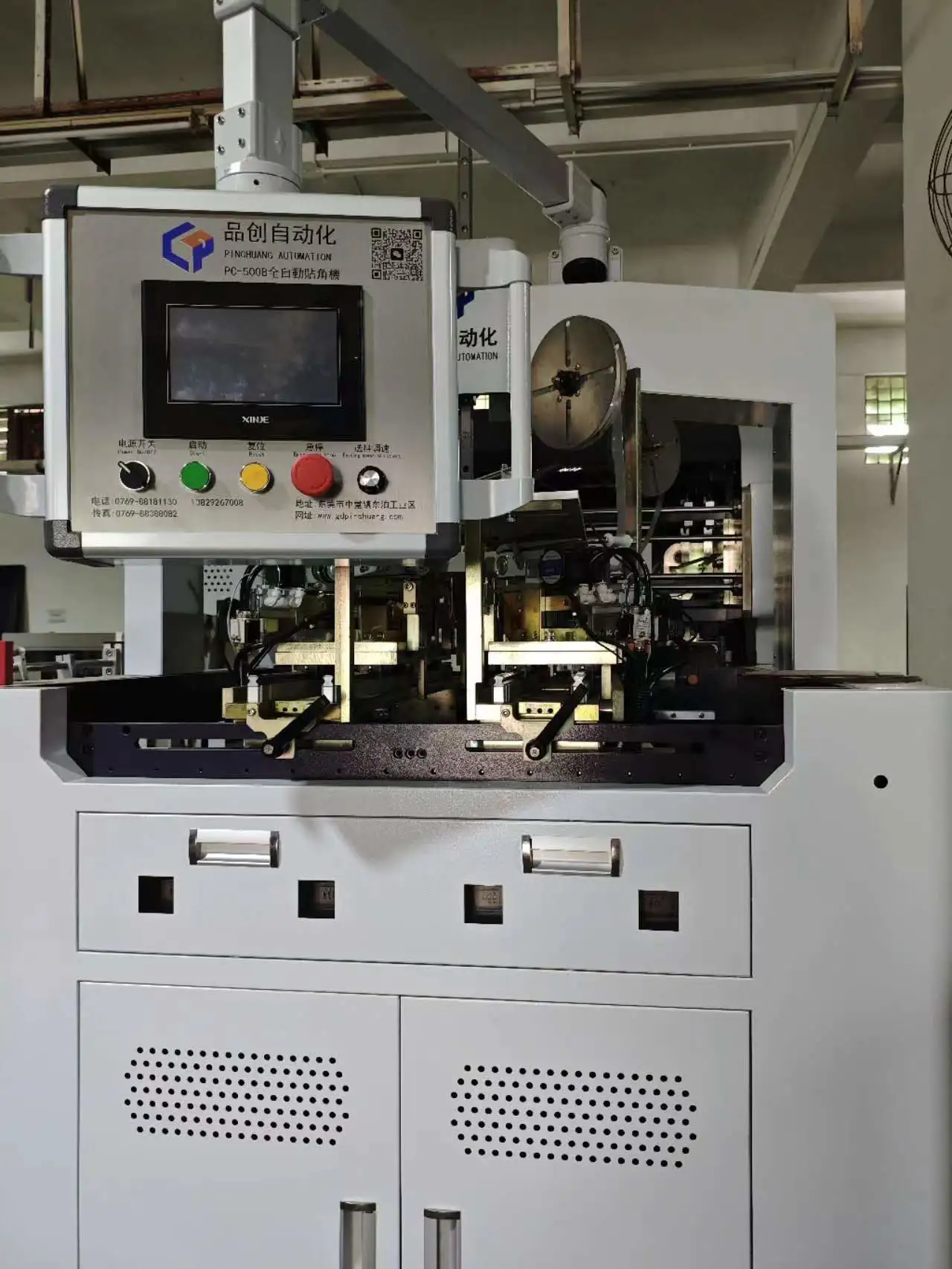
In rigid box manufacturing, the process of pasting corners is a critical step that affects both the aesthetic appeal and structural durability of the final product. Traditionally, manual taping or gluing has been employed to secure box corners, but this method is time-consuming, labor-intensive, and prone to inconsistency. With the rise of automation in packaging, the automatic corner pasting machine has emerged as a more efficient and reliable solution.
This guide explores the differences between automatic corner pasting machines and manual taping, analyzing efficiency, precision, labor costs, and overall production quality. By understanding the advantages and limitations of each method, manufacturers can make informed decisions that optimize their production lines and meet modern market demands.
Understanding the Manual Taping Process
Manual taping has been the standard method for corner pasting in rigid box production for decades. In this process, operators manually fold the corners of each box, apply glue or adhesive tape, and secure the edges. While this method allows flexibility for small production runs or customized boxes, it has several limitations.
Firstly, manual taping is labor-intensive. Skilled operators are required to maintain quality, and even then, consistency can vary from one box to another. Human error may result in uneven corners, excessive glue, or weak bonds, compromising the box's durability and appearance.
Secondly, production speed is significantly limited. An operator can only process a certain number of boxes per hour, and fatigue or repetitive strain can further reduce output. Additionally, manual taping increases material waste, as excess glue or incorrectly folded corners often require rework or disposal.
Despite these drawbacks, manual taping may still be suitable for small-scale production, prototypes, or highly customized designs. However, for high-volume production or luxury packaging requiring consistent quality, alternative methods are necessary.
Efficiency Advantages of Automatic Corner Pasting Machines
The automatic corner pasting machine addresses the limitations of manual taping by automating the folding and gluing process. These machines are designed to handle high-volume production with consistent precision, significantly increasing efficiency.
Automatic corner pasting machines operate with feeding systems, corner folding units, glue application stations, and positioning sensors that ensure every corner is accurately pasted. With minimal human intervention, these machines can process hundreds of boxes per hour, far exceeding the capabilities of manual labor.
Moreover, automation reduces downtime and errors. Features such as programmable settings for box size, corner thickness, and glue volume allow operators to switch between different products quickly. Visual positioning systems and precise glue dispensers ensure each box meets quality standards, minimizing waste and rework.
In terms of labor costs, an automatic corner pasting machine reduces reliance on skilled operators. One operator can oversee multiple machines, allowing manufacturers to allocate human resources more efficiently. For companies producing large quantities of rigid boxes, this efficiency translates to faster turnaround times, lower costs, and higher overall productivity.
Precision and Quality: Automation vs Manual
Precision is a defining advantage of the automatic corner pasting machine. Automated systems apply glue consistently and fold corners accurately, resulting in uniform, high-quality boxes. In contrast, manual taping is highly dependent on operator skill and consistency, making it challenging to maintain quality across large production runs.
Luxury packaging, gift boxes, and high-end product cases require flawless corners to meet customer expectations. The automatic corner pasting machine ensures that each box has precisely folded and glued corners, providing structural integrity and an appealing finish.
Manual taping, even when performed by experienced operators, may lead to minor imperfections, misaligned edges, or uneven adhesive application. Over time, these inconsistencies can accumulate, increasing waste, rework, and customer complaints. Automation eliminates these variables, delivering repeatable results that align with high-quality standards.
Flexibility and Adaptability
While manual taping offers some flexibility for custom or irregular boxes, modern automatic corner pasting machines are increasingly versatile. Machines with adjustable folding units and programmable settings can handle different box sizes, materials, and corner specifications, making them suitable for both standard and customized production lines.
Automatic machines also allow manufacturers to integrate corner pasting into a fully automated production line, working seamlessly with v grooving machines, box assembly machines, and case making machines. This integration not only improves workflow but also reduces manual handling, saving time and minimizing errors.
For manufacturers that frequently switch between product lines, automation offers both speed and consistency, enabling them to meet tight deadlines without sacrificing quality. While initial setup may require planning and calibration, the long-term benefits in production flexibility and efficiency are substantial.
Cost Considerations and Total Ownership
At first glance, manual taping may appear more cost-effective due to lower initial investment. However, when considering total cost of ownership, the automatic corner pasting machine often provides a better return on investment.
Automation reduces labor costs, material waste, and production downtime. Faster production speeds allow manufacturers to fulfill larger orders in less time, increasing revenue potential. Additionally, consistent corner quality reduces rework and defect rates, minimizing losses associated with poor-quality products.
Maintenance requirements for automatic machines are manageable, especially when choosing equipment with modular designs and accessible components. Regular cleaning, lubrication, and occasional replacement of wear parts ensure long-term reliability. For high-volume operations, these benefits outweigh the initial purchase cost, making automation a financially sound decision.
About Our Company and Solutions
Dongguan Pinchuang Automation Equipment Co., Ltd. is a trusted manufacturer of packaging automation machinery. With extensive experience in rigid box production, we specialize in designing and delivering high-performance solutions, including automatic corner pasting machines, automatic case making machines, automatic box assembly machines, and automatic v grooving machines.
Our automatic corner pasting machines are engineered for precision, speed, and adaptability. They are widely used in luxury packaging, cosmetics, electronics, and gift boxes, providing consistent corner quality and reducing production costs.
By partnering with us, manufacturers can optimize their rigid box production lines, enhance efficiency, and deliver high-quality products to their customers. We offer customized solutions, technical support, and global service to ensure smooth integration and reliable operation.
Conclusion
Comparing automatic corner pasting machines with manual taping highlights the significant efficiency, precision, and consistency advantages of automation. While manual methods may still suit small-scale or custom production, automatic machines are essential for high-volume manufacturing, luxury packaging, and operations demanding repeatable quality.
Investing in an automatic corner pasting machine allows manufacturers to reduce labor costs, minimize errors, and increase production speed, ultimately achieving higher profitability and competitive advantage.
FAQ
Q1: What is an automatic corner pasting machine?
An automatic corner pasting machine is a machine that folds, glues, and secures rigid box corners automatically, ensuring consistent precision and high-quality results.
Q2: How does an automatic corner pasting machine compare to manual taping?
It offers higher speed, consistent quality, reduced labor costs, and minimal errors, making it far more efficient than manual taping.
Q3: Can an automatic corner pasting machine handle different box sizes?
Yes, modern machines are adjustable and capable of handling a wide range of box sizes and materials for versatile production.
Q4: Is manual taping ever preferable?
Manual taping may be suitable for small-scale production, prototypes, or highly customized boxes, but it is less efficient for large-scale operations.
Q5: Why should manufacturers choose an automatic corner pasting machine for luxury packaging?
It ensures precise, neat, and durable corners, essential for premium packaging appearance and structural integrity.